

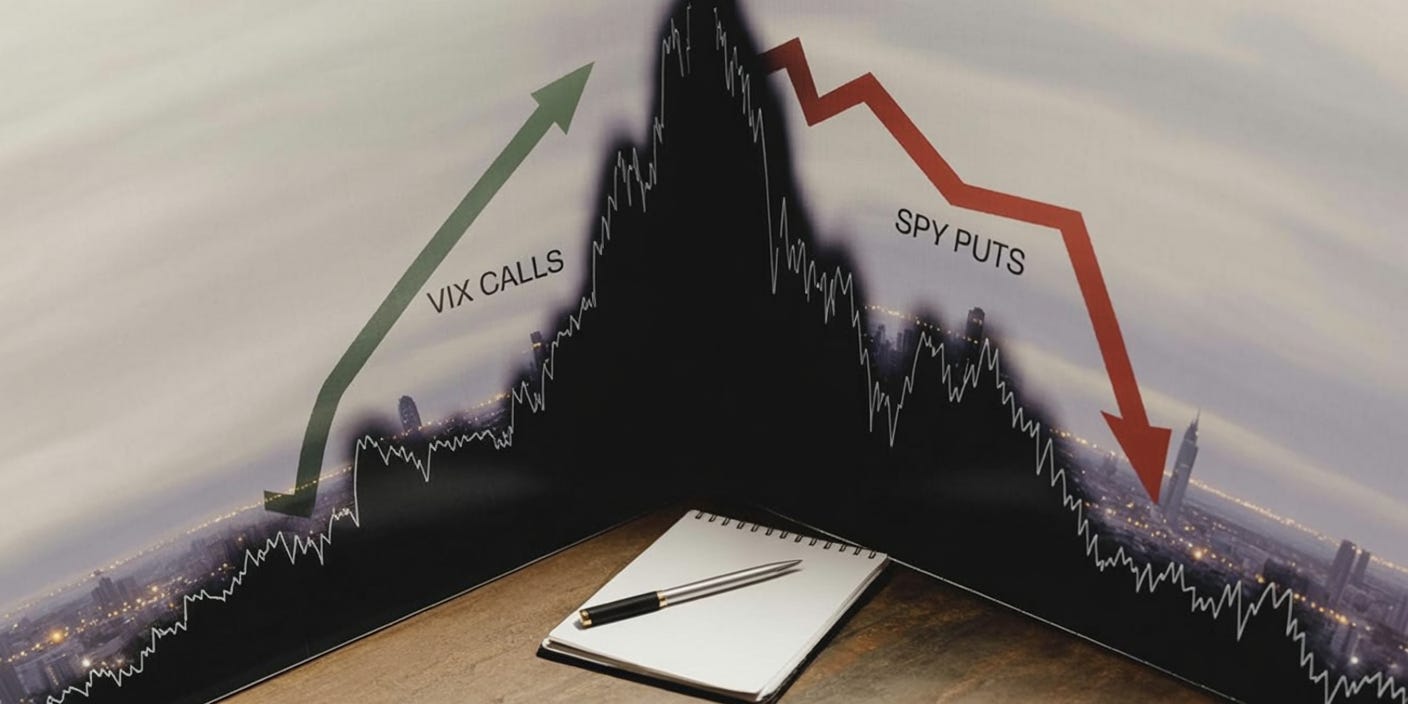
Buying VIX calls is an excellent tool in very specific situations, but it is a poor choice for the vast majority of market environments. Using it indiscriminately is one of the main reasons so many “hedged” portfolios bleed money.
VIX Is a Surprise Hedge, Not a Directional Hedge
Do you not buy VIX calls if you think:
Stocks are overvalued
Stocks need to reprice
We’re going to get a mild 2% pullback
The market is going to go down in a slow and orderly fashion
It is designed to protect against sudden surprises in uncertainty.
In normal or even mildly bearish environments, the VIX term structure is almost always in contango (front-month cheaper than later months). VIX futures-based products must continually roll exposure forward, selling low and buying high. This creates the “bleed.”
Result: Your hedge loses value day after day, even if the market is going down exactly as you feared.
When Buying VIX Calls Works
VIX hedges pay off spectacularly when the market experiences a surprise that causes forced selling. Historical examples:
March 2020 (COVID lockdowns): Overnight shift from complacency to existential fear. VIX spiked from ~15 to 85 in days.
2008–2009 Financial Crisis: When everyone thought the banking system as we know it would collapse. VIX topped 80.
Sudden geopolitical shocks such as if North Kore tests a missile and it accidentally hits Japan.
These are events where the market temporarily loses its ability to rationally price risk.
Buying Puts: The Better Alternative for Most Bearish Views
If your thesis is primarily directional, “the market is overvalued and will reprice lower over time”, buy puts on the underlying indices or stocks themselves.
Advantages:
You get paid purely for downside movement.
No requirement for extreme volatility explosion.
Long index puts (especially longer-dated, slightly OTM) are the correct tool for valuation-based or macro-timing bets.
Practical Rule of Thumb
Ask yourself what type of risk you’re trying to hedge. Most investors default to VIX because it’s marketed as “the fear gauge”, but choosing the wrong tool for the risk you’re facing is why so many hedges lose money consistently. Match the hedge to the risk profile.