

BOIL is an ETF that seeks to deliver twice the daily percentage change of a natural gas futures index.
BOIL does not hold natural gas commodities directly. Instead, it owns futures contracts, which behave differently than the spot price you see quoted on your utility bill.
Why BOIL Is Not a Buy-and-Hold Vehicle
BOIL is seductive but dangerous. It’s a high-volatility trading instrument designed for short bursts of speculation, not for long-term wealth-building. Traders who understand commodity term structures, futures dynamics, and leverage decay can use BOIL strategically. Beginners who treat it like a traditional stock or ETF, however, often lose money.
Over the long run, BOIL trends toward zero due to roll costs and leverage decay.
Big payoffs come only during short-lived natural gas rallies.
For most of the time, BOIL bleeds away capital steadily.
BOIL’s track record is clear:
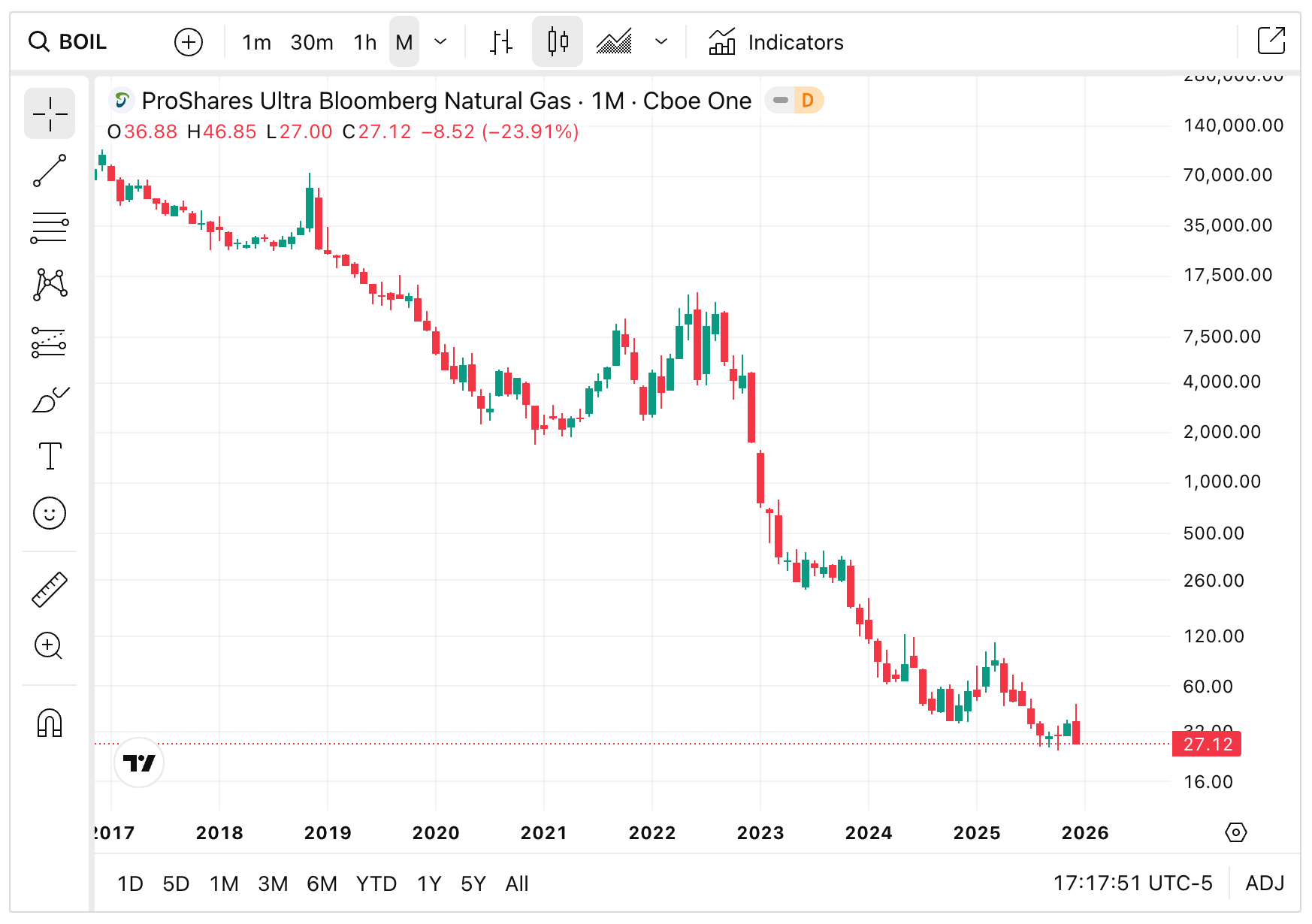
Despite periodic massive spikes in natural gas prices (e.g., during the 2022 energy crisis), BOIL has lost the vast majority of its value over time.
Only Reverse splits keep it trading.
In short: BOIL is a trading tool, not an investment.
Why Does BOIL Go Down Over Time?
Pull up a long-term chart of BOIL, and you’ll see a familiar pattern: relentless decay punctuated by the occasional explosive rally. This trend is the result of two structural forces:
1. Contango in Natural Gas Futures
Natural gas futures are frequently in contango, meaning longer-dated contracts cost more than near-term ones. BOIL which holds long futures will lose value over time as contracts roll down toward the lower spot level.
Additionally, every so often, BOIL must roll futures contracts: sell cheaper expiring ones to buy more expensive ones.
This roll decays the stock.
2. Beta Slippage
BOIL resets daily, aiming for 2x the daily change.
In volatile, choppy markets (common in natural gas), BOIL tends to lose value due to beta slippage due to this daily reset.
Who Should Trade BOIL?
Short-Term Speculators
Traders betting on a near-term surge in natural gas (e.g., during extreme weather, storage reports, or geopolitical shocks).
Traders with short time horizons: days, not months.
Tactical Hedgers
Market participants who want a short-term hedge against energy-related exposure.
Timing is everything though as the longer you hold it the more it erodes the hedge you’re looking for
Who Should Avoid BOIL?
❌ Long-Term Investors
Those looking to “play” natural gas prices over months or years will be disappointed.
❌ Beginners
Without first understanding roll decay, leverage mechanics, and commodity futures structures, beginners shouldn’t trade BOIL.