
How the Rich Get Richer by Delaying IPOs
IPO = “It’s Probably Overpriced.”

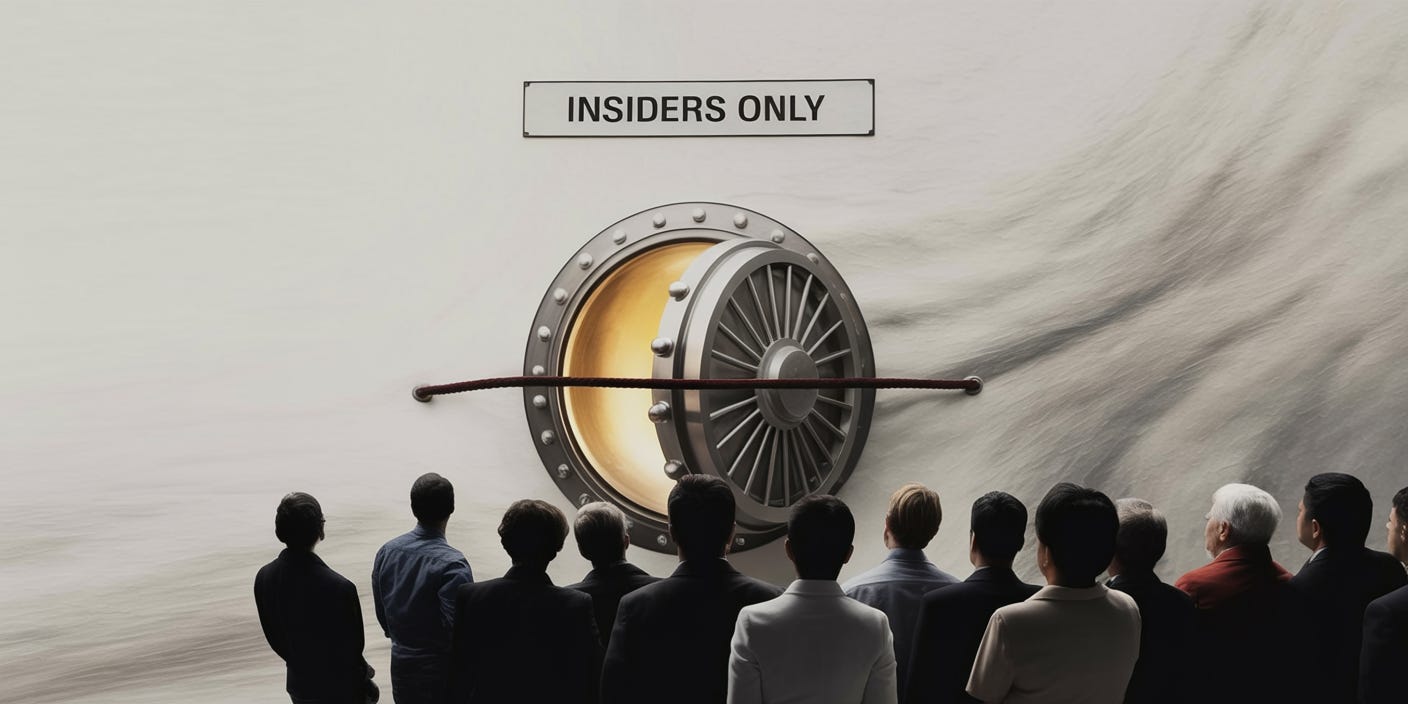
Something fundamental has shifted in American capitalism, especially with new tech and AI companies. These “once-in-a-generation” companies, the ones that grow extremely fast and create massive wealth, are staying private for much longer than they used to.
Insiders Only: How the Ultra-Wealthy Rig the System
Decades ago, high-growth companies went public early. Microsoft, Apple, Amazon all opened their doors to ordinary investors when they were still relatively small. Regular Americans with brokerage accounts and 401(k)s could buy shares and ride the exponential growth alongside the founders.
Today, many of these companies wait years longer. By the time they finally list on the stock exchange, they’re already enormous. Companies are now debuting with valuations over a trillion dollars.
A small group of insiders capture nearly all of the explosive, once-in-a-generation upside because all the rocket-ship growth happens while the company is still private.
This small group captures returns that would have once been distributed broadly across pension funds, retirement accounts, and individual investors.
The early, life-changing returns go entirely to the small circle of private investors. Public investors only get the slower growth that comes afterward.
The Popular Excuse
Founders and executives often say they stay private to escape the pressure of quarterly earnings reports. Public companies face intense scrutiny from Wall Street, and missing a target can tank the stock price. Staying private lets management think decades ahead instead of months ahead.
But mature public markets can handle long-term strategies just fine, and public oversight can actually keep companies honest. So let’s call it what it is: the prolonged “private era” isn’t a noble quest for long-term thinking. It’s a deliberate wealth-concentration tactic designed to make sure the already-rich get obscenely richer while everyone else is locked out.
The longer “private era” means the greatest wealth creation of our time is being captured by a tiny group. Everyday investors are increasingly on the sidelines.
The Retail Investor Arrives Just in Time to Lose
When these companies finally do go public they often debut at nosebleed valuations. Retail investors, lured by the hype, finally get access… but too late. They don’t get the rocket-ship phase. Sometimes they don’t even get the “slow later growth” that insiders claim will come. Far too often, they get the decline: overhyped stocks that pop on day one, then crash and never recover, leaving ordinary buyers holding massive losses while early investors already cashed out billions.

Remember Rivian? An IPO that debuted with massive fanfare, only to collapse and never return to their offering price:
RIVN 0.00%↑ (2021) IPO price: $78 per share.
Years later, the stock is down 80% trading trading at only $16.
Stocks like RIVN aren’t an accident. It’s the system working exactly as the gatekeepers want it to. The greatest wealth creation of our era is being systematically funneled to an ever-smaller elite, while Main Street gets crumbs if they’re lucky or straight losses if they’re not.
Until rules change the game remains rigged.
Sharp analysis on IPO timing dynamics. The RIVN example really drives home the point about retail investors getting stuck at peak valuations. The structural advantage early private investors have is massive when companies can stay private past the hockey-stick growth phase. I've been watching more IPOs fail to hold their offering prices, and it definately seems like a pattern. The lock-up period dynamics make it even worse for late entrants.