The Beginner's Guide to the Sweet Spot for Selling Options
Time decay, or theta, measures how much an option’s value erodes each day as expiration approaches, assuming all else (like underlying price and volatility) stays constant. Theta is typically negative for long options (buyers lose value over time) and positive for short options (sellers gain from decay).
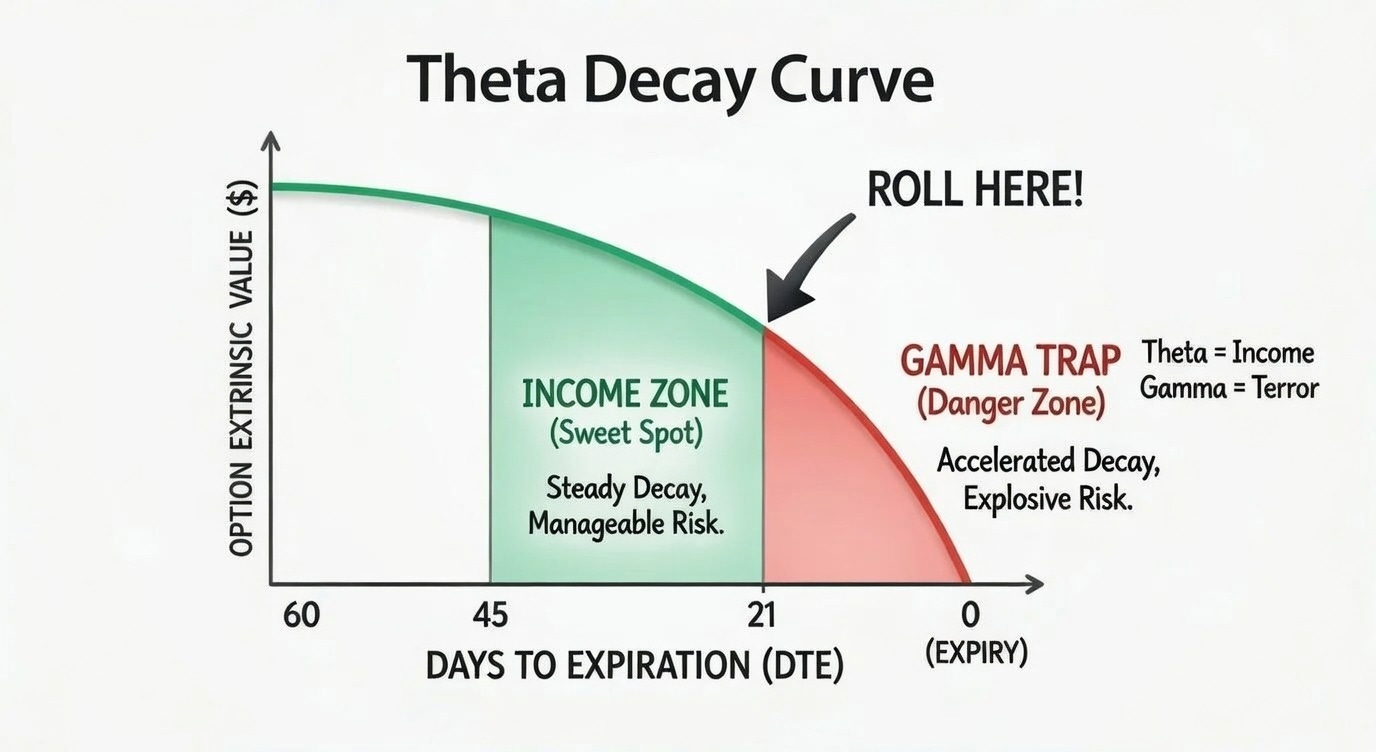
The key feature of theta is that it’s non-linear. Decay starts slow when there are many days to expiration (DTE) and accelerates dramatically as expiration nears.
Here is the classic visualization of this curve:
The 45 DTE Entry and 21 DTE Exit Strategy
This is a popular rule of thumb in premium-selling strategies, popularized by TastyLive (formerly TastyTrade). The idea is to sell options around 45 days to expiration and close/manage around 21 days to expiration.
Why enter at ~45 DTE?
Longer than 45 DTE means spending time in the “flat” part of the curve with low daily decay, reducing return on buying power efficiency.
At 45 days the decay curve starts its decline.
You still get decent premiums, but not excessive gamma risk (your options sensitivity to price movements).
Why close at ~21 DTE?
Between 45 and 21 DTE, you capture a large chunk of the accelerating decay (often 50-70% of the premium if the underlying doesn’t move much).
Below ~21 DTE, gamma risk spikes sharply, especially for at-the-money options. Since short options are short gamma, this increases directional risk as small price moves can cause large P/L swings.
This approach optimizes theta collection per unit of gamma risk, and performs well in mechanical backtests for neutral/short-premium strategies.


